
TV Wall Mounting in Fullerton
TV Mounting Line Fullerton covers everyday TV wall mounting across Fullerton — living rooms, bedrooms and family rooms in a city that holds bungalows from the 1920s, post-war ranch tracts and homes built last decade — where a local installer finds the wood behind the wall, sets a fixed or tilting bracket into it and dresses the cords.
Bookings aren't open yet. Leave your name and number; your message is recorded, and you'll get one message when a local installer is available.
 Illustration
From the box to a hung screen
A standard visit runs the same short sequence, and the sequence is what keeps the picture on the wall.
- Weigh the TV. Weight, VESA hole pattern and screen width are written down first, and the mount must be rated for at least 1.5 times the weight.
- Find the wood. A finder suggests a stud; a thin probe hole under the future plate proves it.
- Outline it in tape. Painter's tape shows the screen on the wall from the sofa before any hole exists.
- Fix the plate. Pilot holes, lag bolts into the studs, a level on the rails.
- Hang and lock. The TV hooks on, and the small safety screw goes in.
What the numbers show
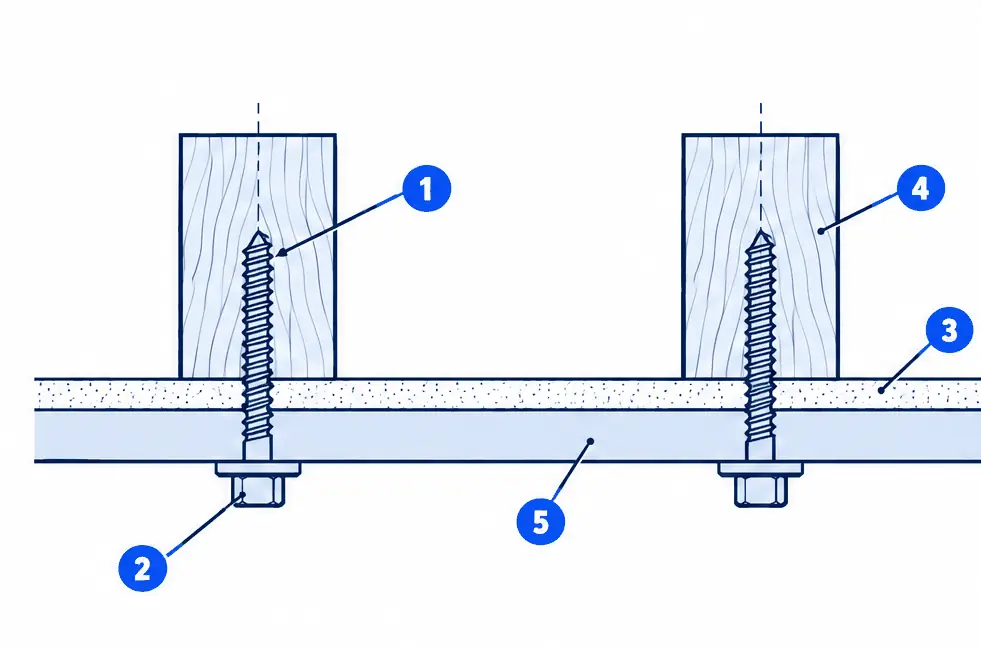
- Thread in the wood The threaded part ends inside the stud; the stud, not the board, holds the weight.
- Head and washer The washer spreads the clamping force over the plate so the head does not pull through.
- Drywall The board covers the framing and carries almost nothing.
- Stud About sixteen inches center to center in most wood-framed houses, with exceptions around openings.
- Plate A wide plate reaches both studs, so the picture can be centered between them.
Fixed against the wall or tipped a few degrees
Two mount types cover most living rooms and bedrooms.
| Mount | Suits | Trade-off |
|---|---|---|
| Fixed | A screen whose middle lands near seated eye height | Closest to the wall, no adjustment later |
| Tilting | A screen mounted above the eye line or facing a window | Stands a little further out, angles the picture down |
A tape outline checked from the sofa answers the question for each room. In a Fullerton house with a tall front window or a French door across from the TV, a few degrees of tilt takes the reflection off the glass in the afternoon.
What the numbers show
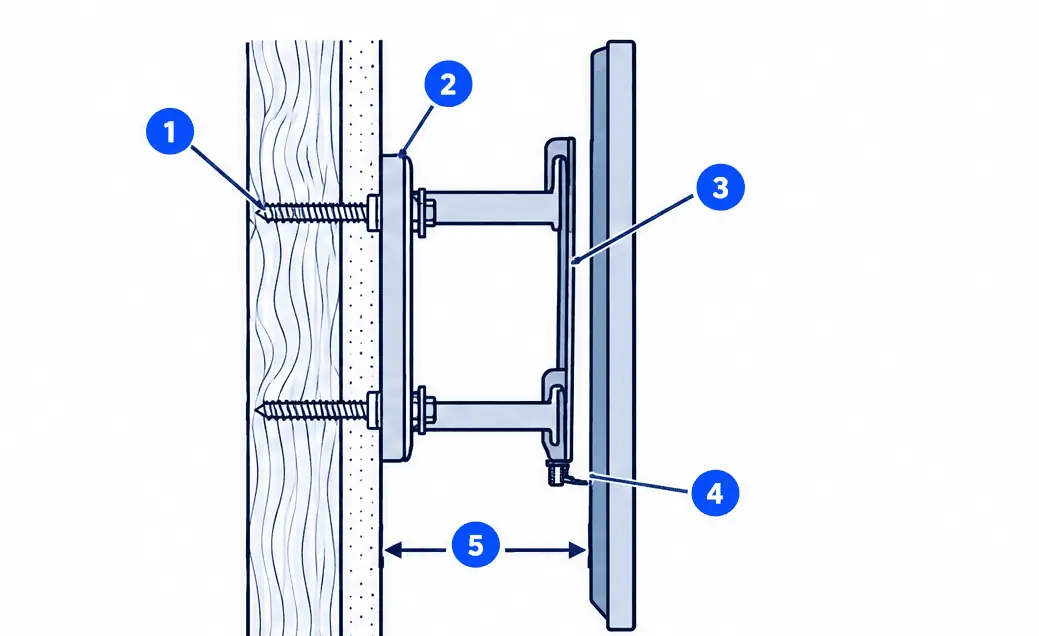
- Lag bolt in the stud Each bolt passes through the plate and the drywall and ends inside the stud, so the TV hangs from the wood and not from the board.
- Rail on the plate The upper rail takes the brackets, and the plate is leveled before the last bolt is tightened.
- Bracket on the TV Two brackets screw into the holes on the back of the set and hook over the rails; the mount is rated for at least 1.5 times the TV weight.
- Locking screw A small screw at the foot of a bracket stops the TV from lifting off the rails after a bump.
- Gap to the wall The gap is just wide enough for plugs, and a fixed mount cannot be adjusted once the TV is hung.
Studs that miss the center of the picture
In a 1920s house the studs do not always keep a tidy spacing, and in a house remodeled twice they follow the remodel, not the plan. When the middle of the picture falls between two studs, the plate usually spans both. When it cannot, a plywood or steel backer fixed across three or more studs gives the plate a solid face while the picture stays centered.
- Wide plate reaches two studs.
- Backer panel spreads the load over three or more.
- Hollow-wall toggles are a last resort for a light screen, never a stand-in for wood under a large one.
Cords and the finish
The cleanest simple finish drops the cords straight down behind the TV and ties them in a short bundle above an outlet that sits low and close. A slim raceway painted the wall color tidies the run without opening anything. Hiding the wires inside the wall is its own job with its own add-on and its own rules; a standard power cord never goes inside a wall, only an in-wall rated kit does, and a new outlet is work for an electrician.
TV Wall Mounting — common questions
How much does a basic TV wall mount cost in Fullerton?
Expect roughly $100–$140 for a 32–49 inch set and $120–$170 for 50–65 inches on drywall over wood studs in 2026. Bigger TVs and harder walls move the figure up.
Does the TV need a special bracket?
It needs one rated for the TV's weight whose arms match the mounting holes on the back of the set. A bracket the household already owns is checked against both before it goes on the wall.
Availability & price range
TV Wall Mounting: check availability and price range
Bookings aren't open yet — answer a few quick questions about the TV and the wall and get a typical Fullerton price range right here. Typical Fullerton prices for one TV, labor only unless an option says otherwise. This is a market estimate, not a quote.